.png)
The Social Reckoning - Film Review

To waste no time, I want to start by acknowledging that I am one of those guys that can watch an Aaron Sorkin film and not recoil from the probably unrealistic and pretentious authorial-voice ingrained in the dialogue: I too am unfamiliar with how normal people talk I guess. Sorkin has returned to his FCU (Facebook Cinematic Universe) in a follow-up to 2010's The Social Network (directed by David Fincher and written by Sorkin). The Social Reckoning (releasing in theaters Oct. 9th) covers a period from 2019-2021 as an investigative journalist with the Wall Street Journal (Jeremy Allen White) works alongside a Facebook employee (Mikey Madison) to expose Facebook for it's failure to curb known abuses within their algorithm, culminating with the release of the so-called Facebook Files.
This new film is written and directed by Sorkin, and some of the most obvious downgrades it has in comparison to The Social Network comes from that fact. Network wasn't Fincher's flashiest or most expressive work (which isn't saying much considering that few would call him a flashy director), but it might've been the most naturalistic of his that I'm familiar with. Reckoning doesn't look bad per se, but it does have a certain grey, low contrast, high-focus style which puts it more in the visual language of a Netflix docuseries.
On top of this, on my rewatch of The Social Network the other night I was reminded of its electrifying score by Trent Reznor and Atticus Ross. The Social Reckoning's score opts for a more subdued sound, content to lay in the background for its runtime. The film's composer Alexandre Desplat certainly did some fine work, but it doesn't quite compare in impact to Reznor and Ross's work.
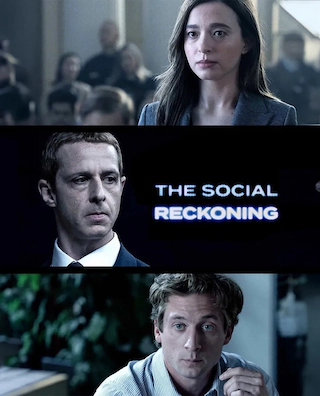
But maybe this reveals a problem here: sure Reckoning doesn't really match up to Network, but why should it? Aside from my joke about an FCU, this isn't really much of a traditional sequel, and comparing the two might not be useful. In terms of genre and experience, The Social Reckoning aims for more of a legal thriller than Network's more straight-ahead adult drama. As such, the film bears more structural similarity to Sorkin's The Trial of the Chicago Seven, building up to one big moment with something of a put-up-or-shut-up energy. It's through this that we can see most of the The Social Reckoning's greatest strengths.
First off, I need to admire the pacing, which is genuinely excellent (forgiving a slow start). The film uses different timelines and groups of characters but remains hyper-focused on just a few strains of character development and conflict. The bulk of it comes down on Mikey Madison and Jeremy Allen White's performances, and how they work off of one another to keep the film moving. Both actors put forward really great, highly believable work, feeling richly emersed in their characters and the way they're friendship builds feels very believable. Madison's character's arc is really the defining characteristic of the film, residing on her gradual alienation with Facebook despite her initial optimism and belief in what she thought it stood for.
As for the rest of the cast I can't say I have many major complaints. Jeremy Strong absolutely nails Zuckerberg's accent and mannerisms (though I find Sorkin's writing for the character to not have as much to add). One of the film's most interesting decisions is to use many of the characters around Zuckerberg to almost infantilize the CEO, demonstrating the way he has to be coached about basic human behaviour.
This infantilization also leads to an interesting moment near the end of the film where Zuckerberg has a Christopher Nolan-protagonist moment of "oh no this thing I've made to do blank is doing blank". This serves as Zuckerberg's primary arc throughout the film and it paints him in a weirdly resignedly-moral light which doesn't sit all that well with me. But that is slightly offset by the undeniable harm that Facebook and its turbo-capitalistic profit-chasing is exacting on our world.
However, this particular focus for Zuckerberg's character also has the consequence of necessitating Bill Burr's character in the film as a consultant and primary moral opponent for Zuckerberg to face off against. Unfortunately, funny as Bill Burr may be, his characters always come across indistinguishable from Bill Burr himself.
Despite taking place during the initial outbreak, the film puts little focus and effort into fully tackling the implications of that era. This is not an unusual approach for media to take, for one reason or another there seems to be a shyness in trying to go back to that time.
I understand that this lies outside the scope of the film, and it is likely better off for narrowing its focus to exactly what its central narrative actually covers. But it does feel like a weakness to gloss over something so irrevocably important to anything happening during that time period.
Otherwise, the film does well to tackle the thematic weight of Facebook's willful violations of human ethics and empathy, how they traded away opportunities to right their own wrongs and restore some degree of social welfare for even a fraction of their revenue. Many of the best lines come from this thematic dialogue about the roles of these multinational corporations.

Verdict:
The Social Reckoning is a good film, engaging and well paced with several strong performances and overall palatable writing, direction, and score. Despite minor critiques that Sorkin's writing dipped in terms of wit and sharpness, I don't really have a massive flaw to point towards.
However, its worst characteristic is its inescapably-manufactured feeling. To explain, when watching I could never quite get submersed entirely in the story, there were always little eccentricities which brought me out. I've already noted Bill Burr's non-acting, but there's also the broadly awkward implementation of humour which usually feels telegraphed and segregated, like you can see exactly where in the dialogue Sorkin was inserting a joke.
On top of that I have a few niggles regarding the sets and costumes. One of these came down to the fairly low-key approach towards the COVID-19 Pandemic, the feeling of which was never really captured in the actions and environments of the characters. The other was the sort of cop-out used to put Mikey Madison in fashionable dresses for much of the film, something which I just couldn't help but know came down more to the pursuit of eye-candy than it did as a natural consequence of the script.
I can't vouch for the film's accuracy to its dramatized reality, but I can say that (despite many minor flaws), it's a fun time and left me satisfied with how it handled the scope of its narrative.
Paul Taylor - Web Content Director
Interested in writing for wxou.org? We are eager to feature your voice! Please email me at webdirector@wxou.org


Comments